
Credits: Nick Thake
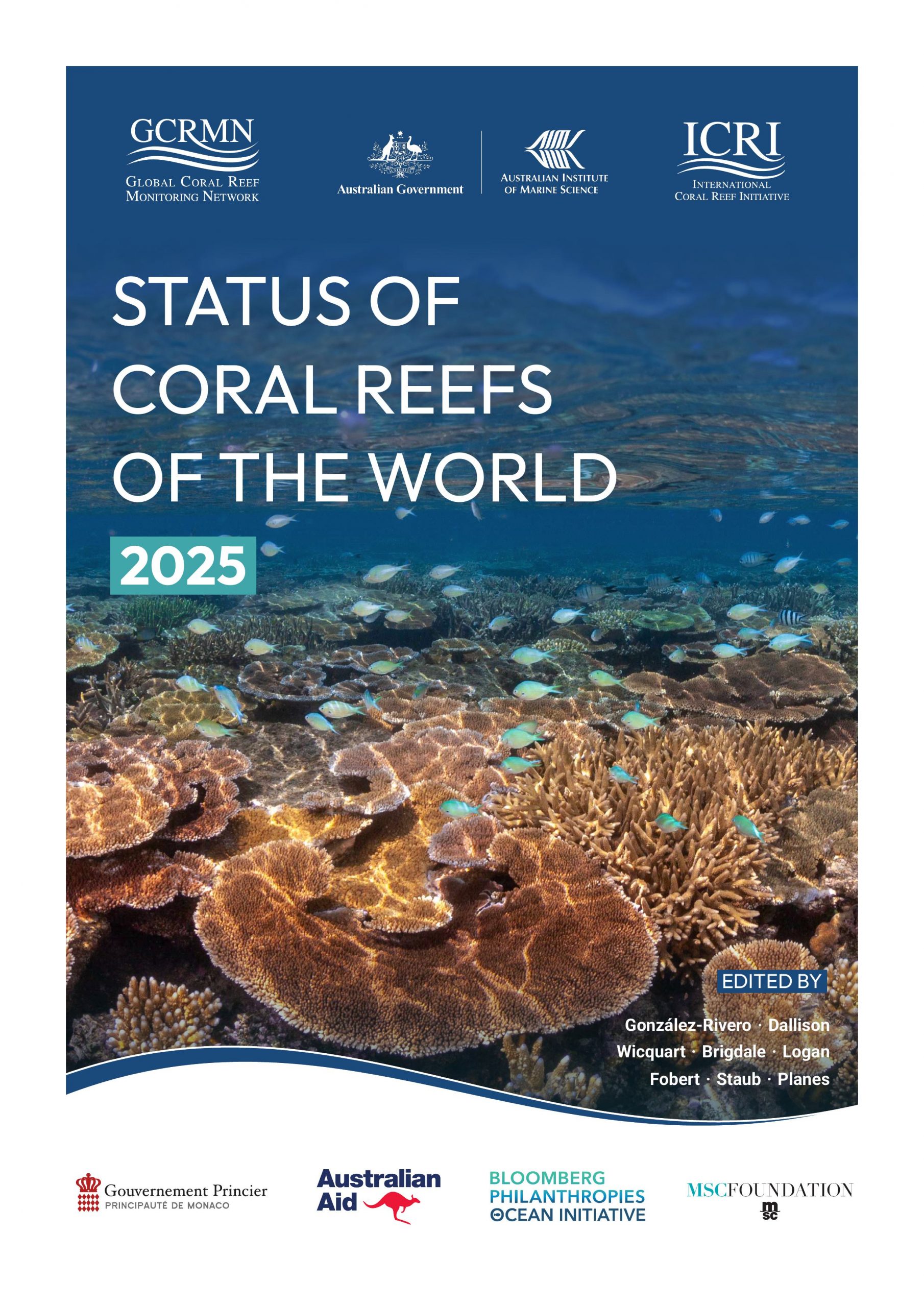
Status of Coral Reefs of the World: 2025
From Science to Action: Securing the Future of Coral Reefs
The most comprehensive assessment to date of the status and trends of coral reefs, from 1980 to 2024, at global and regional scales.
Coral reefs are among the world’s most valuable natural assets — living infrastructure supporting food security, livelihoods, coastal protection, economies, biodiversity and cultural identity for close to one billion people. But they are changing at an unprecedented rate across many regions, and the primary driver is climate change. As ocean temperatures continue to climb and local pressures mount, the window to safeguard these ecosystems is rapidly closing — making timely, evidence-based action more critical than ever.
Global status and trends of coral reefs
The Status of Coral Reefs of the World: 2025 — the GCRMN’s seventh edition and most comprehensive assessment to date — examines change in hard coral and macroalgal cover from 1980 to 2024 at global and regional scales. Across the 10 GCRMN regions, four are in long-term decline, four show no net change and two are increasing relative to the reference period. The report highlights the key drivers of change, and equips governments, reef managers and communities with the evidence base to prioritise interventions, strengthen resilience and direct resources where they can have the greatest impact.
The largest coral reef dataset ever assembled
With contributions by 600 partners across more than 120 countries, territories and economies, the data are coordinated through the GCRMN’s open gcrmndb_benthos repository under the FAIR data principles. Established in 1995, the GCRMN brings the world’s reef monitoring into a single, standardised evidence base — 2025 marks 30 years; this report is its seventh edition. An independent external review was coordinated by the International Coral Reef Society (ICRS).
Key findings
Climate change is the dominant driver
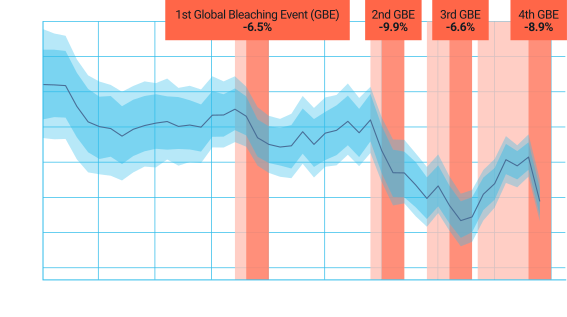
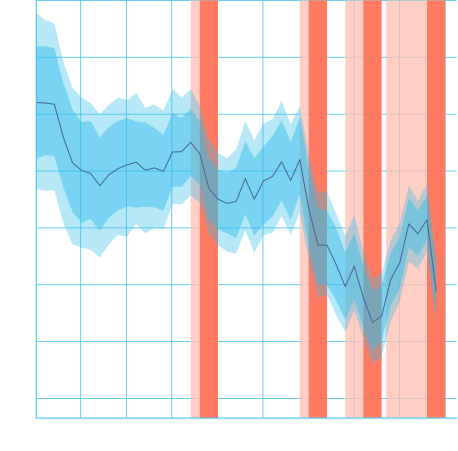
Climate-driven marine heatwaves — and the global bleaching events they drive — are the primary cause of the global decline in hard coral cover, now a recurrent and escalating pressure rather than episodic. Major declines align with the events of 1998, 2010, 2016 and 2023–24.
Reefs can recover, if given the chance
Following the third global bleaching event, global hard coral cover rose by a relative ~6% between 2017 and 2019 — showing reefs recover when disturbance eases — but shortening windows between events are driving a stepwise decline in coral cover.
The picture varies by region
Of the 10 GCRMN regions, four show long-term declines, four show no net change, and two show increases relative to the reference period. Effective protection needs coordinated local, national and global action.
What we measure matters
Hard coral cover alone does not fully represent reef condition. Sustained long-term monitoring of a broader set of indicators — including macroalgae, which remains low globally — is essential to detect change, attribute drivers and manage adaptively.
The future is not fixed
At the current frequency of global bleaching events (every 5–6 years) reefs are expected to keep declining; ambitious emissions cuts combined with effective local management offer the strongest pathway to halt the loss of hard coral cover.
After decades of studying coral reefs, what concerns me most isn’t the current loss of hard coral cover; it’s that we’re steadily eroding the conditions they need to recover.
Dr Manuel González Rivero, lead author
A global assessment, region by region
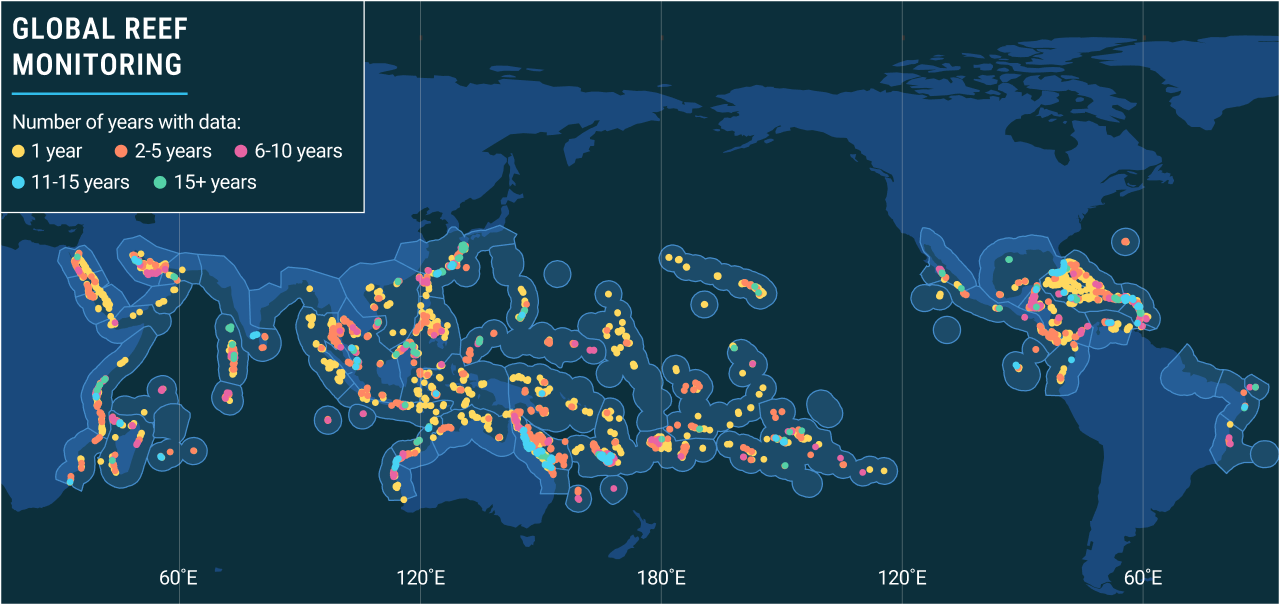
Global patterns do not play out the same everywhere: across the 10 GCRMN regions, some have experienced greater loss while others are stable or increasing.
From science to action
The science is clear: delayed action on climate change risks locking in irreversible losses — undermining ecological resilience, human well-being and the global policy ambitions designed to safeguard them. Holding the global average temperature rise well below 2°C, and pursuing 1.5°C under the Paris Agreement, is fundamental to whether coral reefs persist through this century. Reducing local stressors, strengthening protection, adaptive management and sustained monitoring are consistently associated with improved reef condition and recovery.
The evidence base informs progress under the UN Framework Convention on Climate Change, the Kunming-Montreal Global Biodiversity Framework — 16 of whose 23 targets are highly relevant to coral reefs — the Sustainable Development Goals and the Paris Agreement. It supports ICRI’s Key Policy Asks for Coral Reefs: Accelerating the Decade of Action (2025) — eight interconnected pathways — UNEA Resolution 7/1, and IUCN Resolution WCC-2025-Res-037.
What comes next
Six priorities for global monitoring
Funding
Increase funding, particularly in developing nations.
Coverage
Expand temporal and spatial coverage in understudied regions
Standardisation
Guide the standardisation of monitoring practices
Discoverability
Improve data discoverability and interoperability under the FAIR principles
Resolution
Increase taxonomic resolution and the diversity of indicators, aligned with the Essential Ocean Variables
Integration
Integrate ecological and socio-economic indicators for whole-system decision-making.
Why coral reefs matter
Downloads & resources
How to cite: Global Coral Reef Monitoring Network (GCRMN) (2025).
Status of Coral Reefs of the World: 2025. González-Rivero, M., Dallison,T., Wicquart, J., Brigdale, A., Logan, M., Fobert, E. K., Staub, F., and Planes, S. (eds.), 2026. Status of Coral Reefs of the World: 2025. Global Coral Reef Monitoring Network (GCRMN), International Coral Reef Initiative (ICRI). https://doi.org/10.59387/LFPR6347
Regional chapters
SCIENCE-TO-ACTION BRIEFs
Acknowledgements & disclaimers
The Status of Coral Reefs of the World: 2025 reflects the work of the GCRMN’s global network — 600 partners across more than 120 countries, territories and economies — together with its partners and funders.
This report contributes to the United Nations Decade of Ocean Science for Sustainable Development (2021—2030).
Data Accessibility
The GCRMN produces estimations regarding the status and trends of coral reefs of the world using data acquired by the members of the GCRMN network. The data are collected following Data Sharing Agreements (DSA) with data contributors and as such the GCRMN is not the owner of datasets shared by its members. Therefore, for the “Status of Coral Reefs of the World: 2025” report, the GCRMN is unable to share the raw datasets. However, some members of the GCRMN network and report contributors have made their datasets publicly available. For benthic cover monitoring data, such open access datasets are listed here.
Financial supporters of the
Status of Coral Reefs of the World: 2025

#WorldCoralReefStatus #ForCoral #GCRMN
Join the conversation on LinkedIn
All related Social Media assets can be found in the Social Media Toolkit, including regional posts and tiles.