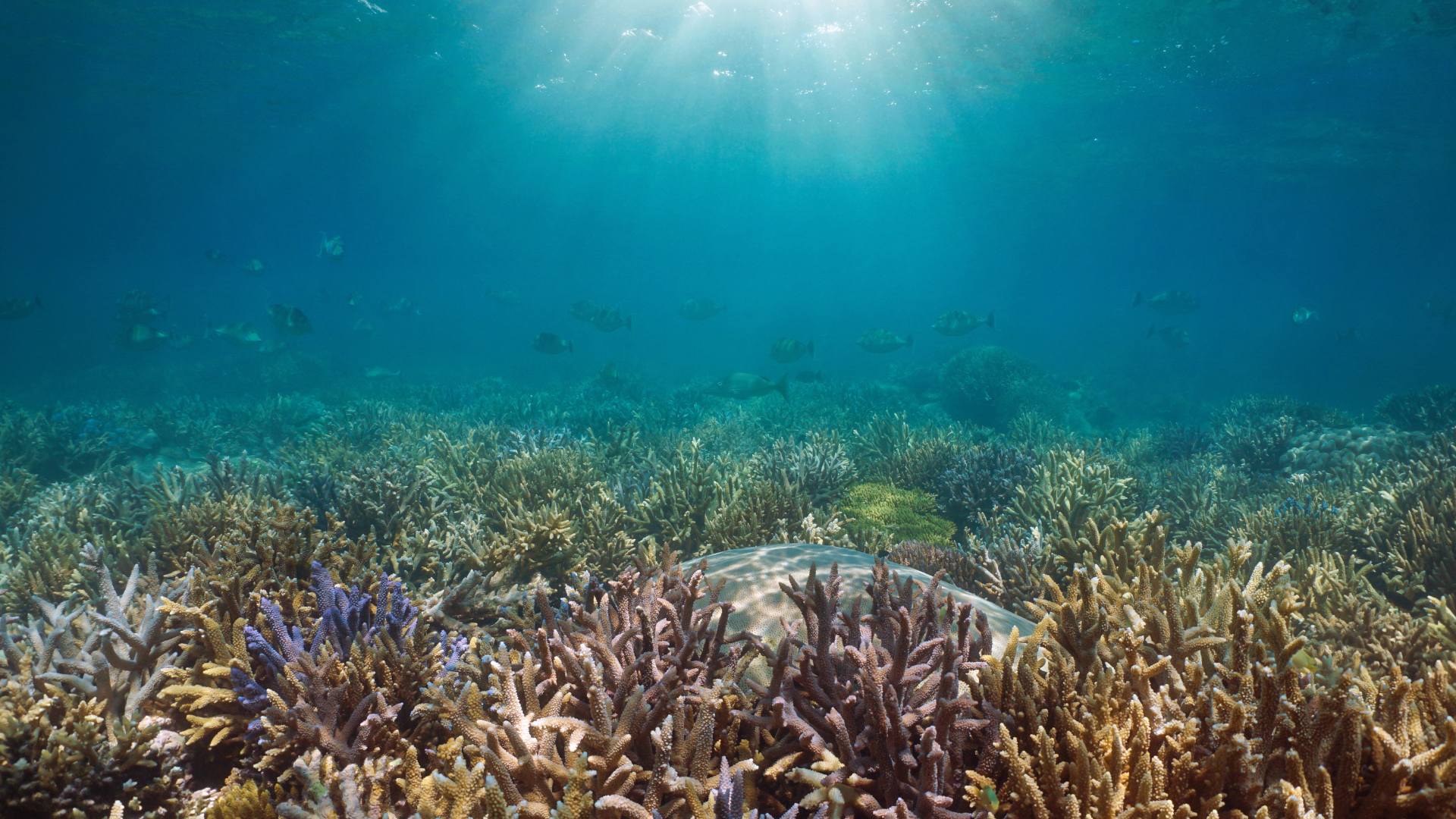
A new technical report from the National Oceanic and Atmospheric Administration (NOAA) presents the latest findings from the National Coral Reef Monitoring Program (NCRMP), documenting over a decade of coral reef trends (2013–2024) at the East and West Flower Garden Banks.
The report provides a comprehensive assessment of coral and fish communities based on long-term, standardised monitoring, offering important insights into reef condition and population dynamics at one of the healthiest coral reef systems in the wider U.S. Atlantic region.
Consistently high coral cover and low mortality
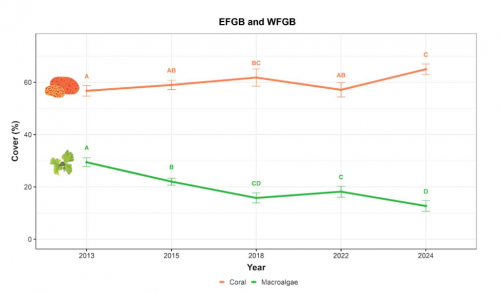
The 2024 surveys confirm that coral cover at the East and West Flower Garden Banks has remained consistently high since monitoring began in 2013, exceeding 50% throughout the time series and reaching an estimated 65.0% (± 4.1) in 2024. This represents the highest coral cover recorded across U.S. Atlantic coral reef jurisdictions.
This high cover is driven by the persistence of large, reef-building coral colonies, including massive species such as Orbicella franksi, O. faveolata, and Siderastrea siderea, alongside extensive fields of branching Madracis auretenra. Colonies frequently exceed one metre in diameter, and overall mortality remains low, with limited evidence of both recent and historic coral loss.
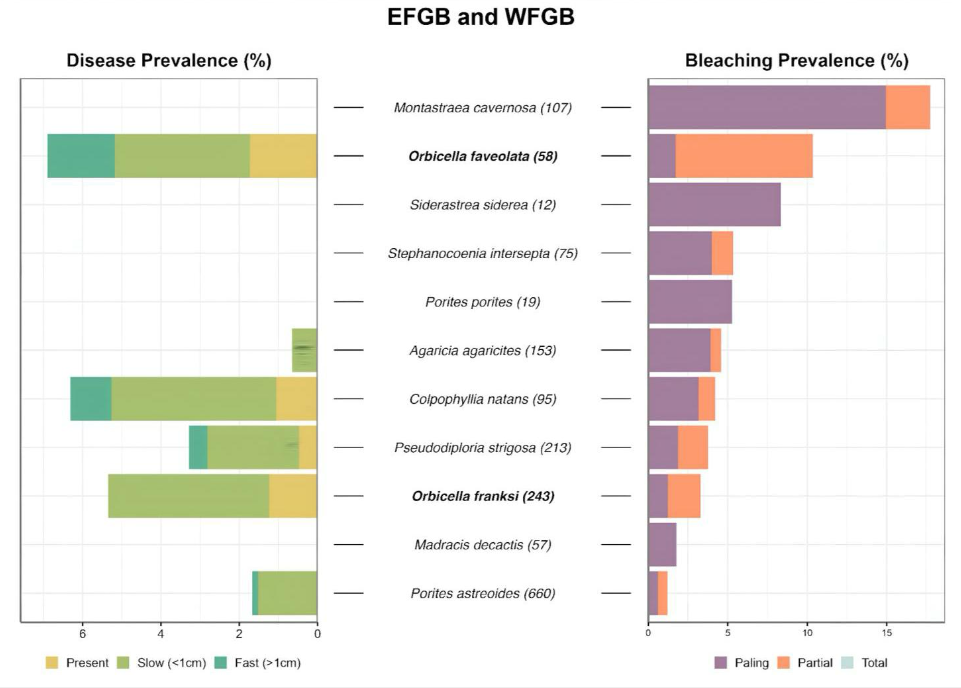
Importantly, while coral bleaching was observed in 2023 and disease has been present since 2022, these pressures have not translated into widespread mortality. The report notes only low levels of recent mortality across surveyed species, indicating continued resilience of the reef system.
Stable populations and long-term trends
Across the 2013–2024 period, key reef-building species show relatively stable population structures, with consistent size distributions and densities over time. While partial bleaching, paling, and disease were observed in 2024, no total bleaching events were recorded during surveys, and overall impacts remained limited.
The report also highlights a decline in macroalgae cover over time, alongside sustained coral dominance, further reinforcing the ecological condition of the reefs.
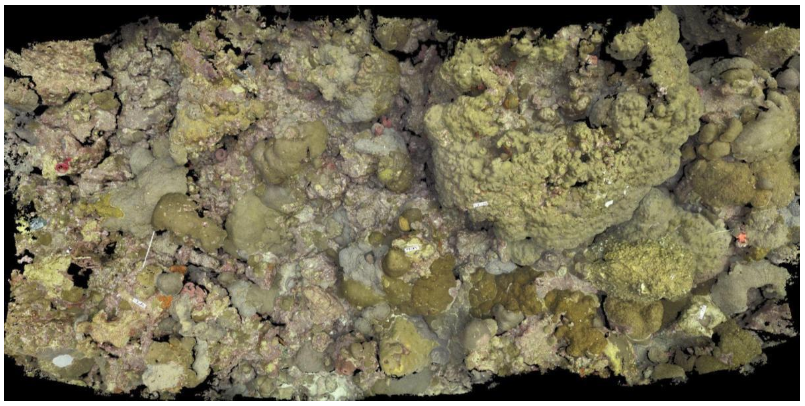
(left) Large area imagery (LAI) of a NCRMP benthic transect at East Flower Garden Bank in 2024. Survey area is approximately 15 x 3 m. Scale bars are visible in the image, and (right) disease prevalence (left) and bleaching prevalence (right) by coral species from NCRMP 2024 surveys at East Flower Garden Bank (EFGB) and West Flower Garden Bank (WFGB). Only species with disease or bleaching observed in the NCRMP coral demographics surveys are included. Bolded species are ESA-listed.
Diverse and dynamic fish communities
Reef fish communities at the Flower Garden Banks remain diverse, with 101 species recorded in 2024 surveys. The assemblage is dominated by smaller demersal and pelagic species, including creole wrasse, brown chromis, Atlantic creolefish, bluehead wrasse, and bicolour damselfish.
Among commercially and ecologically important species, population densities have shown natural variability over time but no significant long-term trends. Length-frequency data indicate the presence of mature individuals across key species, supporting ongoing reproductive capacity.
Notably, a strong recruitment pulse for yellowmouth grouper first observed in 2022 was again evident in 2024, with many individuals approaching reproductive maturity.
Monitoring context and data limitations
The 2024 surveys covered 38 sites across both banks, fewer than in previous years due to challenging sea conditions, which contributed to increased variability in fish density estimates.
NCRMP monitoring is conducted on a multi-year cycle using stratified, standardised survey methods, providing a robust basis for detecting long-term trends in coral reef ecosystems. The data complement local monitoring efforts and support management decisions related to coral health, fisheries, and ecosystem condition.
A resilient reef system within a changing ocean
The findings highlight the Flower Garden Banks as a coral reef system characterised by high coral cover, low mortality, and stable fish communities over more than a decade of monitoring. While signs of stress such as bleaching and disease are present, their impacts remain limited compared to other regions.

Citation:
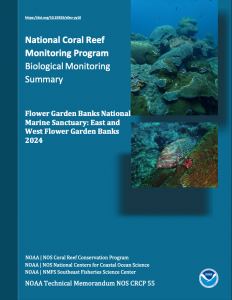
Title : National Coral Reef Monitoring Program Biological Monitoring Summary : Flower Garden Banks National Marine Sanctuary: East and West Flower Garden Banks 2024
Personal Author(s) : Grove, Laura Jay W.;Viehman, T. Shay;Blondeau, Jeremiah;Cain, Erin;Edwards, Kimberly F.;Krampitz, Nicole;Langwiser, Caitlin;Mateski, Julia;Sturm, Alexis B.;Swanson, Dione W.;Towle, Erica K.;
Corporate Authors(s) : Coral Reef Conservation Program (U.S.);National Centers for Coastal Ocean Science (U.S.);Southeast Fisheries Science Center (U.S.);Cooperative Institute for Marine and Atmospheric Studies (Key Biscayne, Fla.);CSS, Inc.;
Published Date : 2025
Series : NOAA technical memorandum CRCP ; 55
DOI : https://doi.org/10.25923/x0nz-yy10