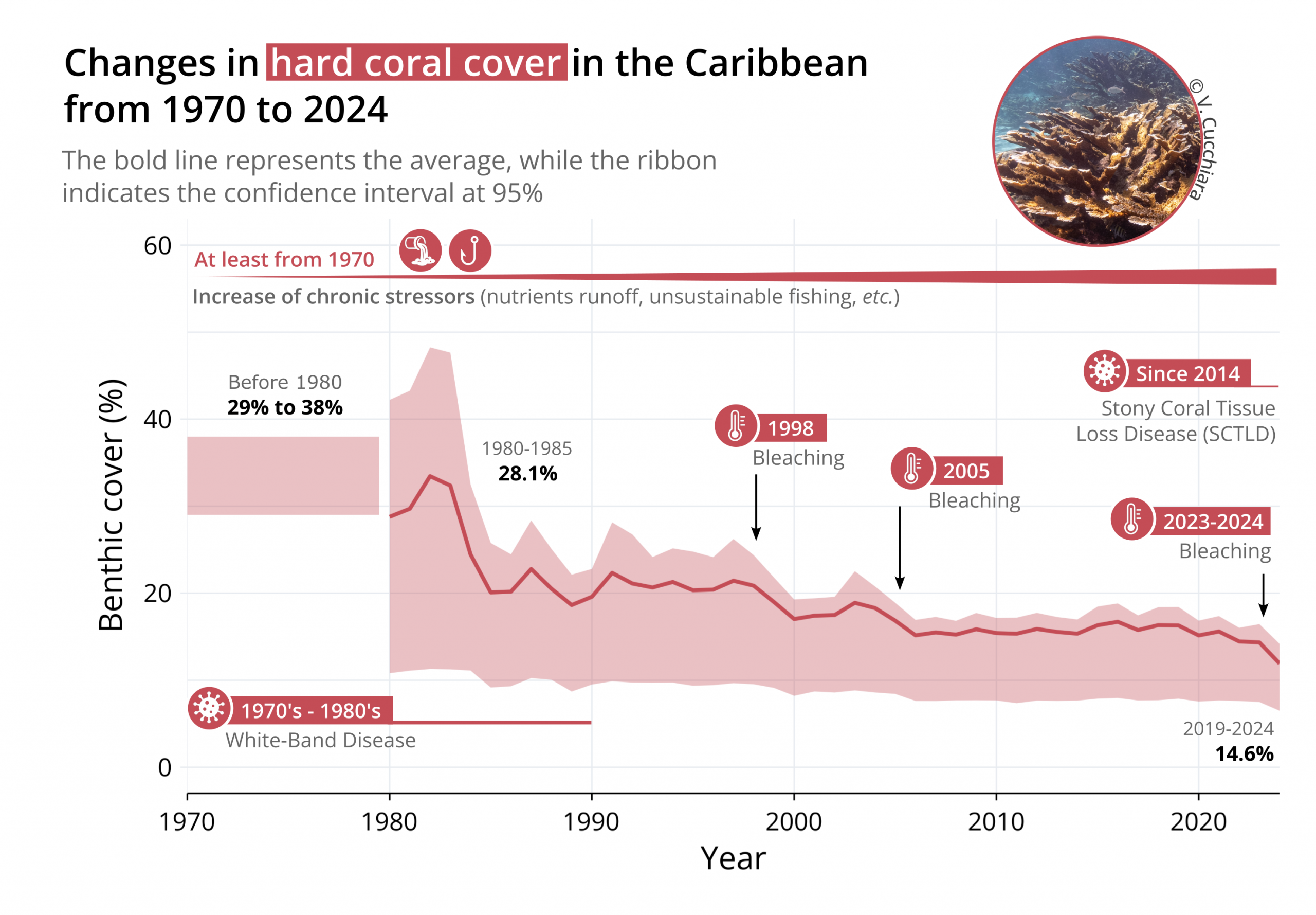
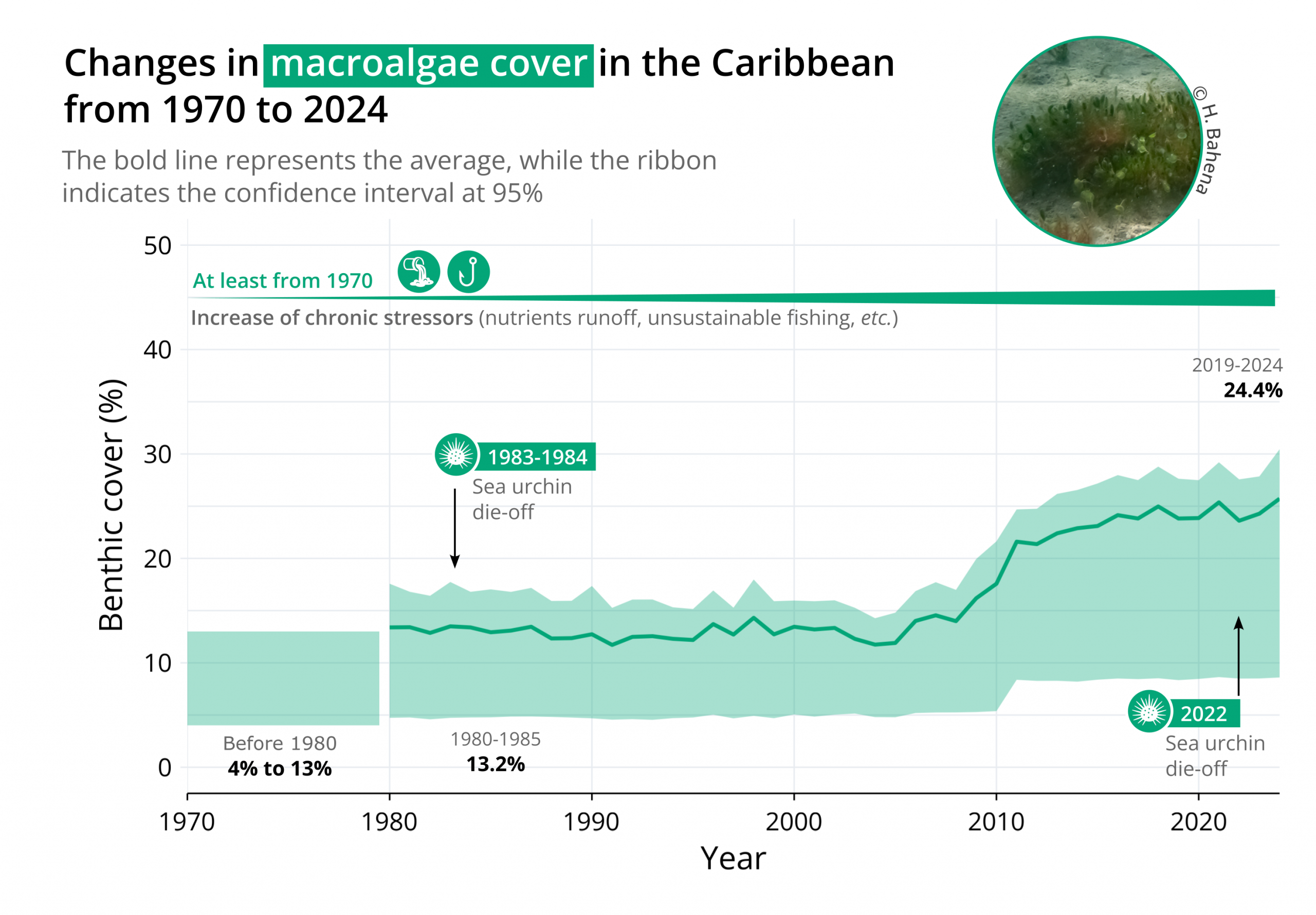
9th December 2025, Wider Caribbean Region – Coral cover in the Caribbean has declined by 48% since 1980 while macroalgae cover has risen 85% in the same time, according to a major new report by the Global Coral Reef Monitoring Network (GCMRN). The GCMRN, an operational network of the International Coral Reef Initiative (ICRI), found that these changes are largely driven by climate change-induced heat stress, overfishing, and diseases.
KEY FACTS
- Hard coral cover declined by 48% from 1980 to 2024, meaning that hard corals now occupy half of the benthic cover they occupied in 1980.
- Hard coral cover declined sharply in 1998 (-9.0%), 2005 (-17.1%), and 2023 (-16.9%) due to bleaching events, induced by thermal stress.
- Hard coral assemblage shifted from branching species to more massive species, thereby decreasing the structural complexity of Caribbean coral reefs.
- Macroalgae cover increased by 85% from 1980 to 2024 due to the decline in herbivorous species (e.g. parrotfish, sea urchins) and the increase in nutrients.
- Mean sea surface temperature over coral reef areas across the Caribbean increased by +1.07°C between 1985 and 2024, driven by climate change, representing a warming rate of +0.27°C per decade.
- The number of people in the Caribbean living within 20 km of coral reefs increased by 27.6% from 2000 to 2020 at the regional scale, representing an increase of 13 million people.
- Coral reefs of the GCRMN Caribbean region cover 24,230 km² which represent 9.7% of the world’s coral reef extent.

In the Caribbean, reefs generate $6.2 billion annually through fisheries and tourism, with reef tourism representing 23% of all tourism spending and over 10% of the Caribbean’s gross domestic product (GDP).
As reefs degrade, their ability to provide food, sustain fisheries and buffer coasts from storms and hurricanes is compromised. The number of people living within 20km of coral reefs has increased by 27.6% since 2000 (an additional 13 million people), which has not only increased pressures, but also increased reliance on these systems—raising the number of people at risk from diminishing coral reef services.
HOPE & OPPORTUNITY
Despite the scale of decline, the report highlights evidence of recovery where local pressures are effectively managed. Protected or well-managed reefs show higher coral cover, greater biodiversity and stronger resilience to heat stress.
Across the region, multiple success stories demonstrate that progress is possible:
- 30 years of Red Hind protection in the Red Hind Bank Marine Conservation District in the U.S Virgin Islands led to a 35% increase in fish size.
- Fully protected Marine Protected Areas in Mesoamerican Reef Region host higher biomass of commercial and herbivorous fish
- Coral restoration in SAMAR (Santuario Marino Arrecifes del Sureste), a co-managed Marine Protected Area of >1,800 km² in Dominican Republic, is benefiting from a long-term joint monitoring
- Some reefs are still thriving even in highly disturbed areas, such as the Varadero reef in Colombia, hosting 42 hard coral species with 40-60% hard coral cover.
These examples highlight that local action delivers measurable recovery, buying valuable time as global efforts to reduce greenhouse gas emissions continue.
PATHWAYS FORWARD
The report outlines five priority recommendations for governments, partners and the private sector to strengthen reef resilience and protect coastal livelihoods:
- Integrate coral reefs into national climate and biodiversity strategies, embedding reef targets into Nationally determined contributions (NDCs), National Adaptation Plans (NAPs), and National Biodiversity Strategies and Action Plans (NBSAPs)
- Reduce greenhouse gas emissions, improve water quality and reduce local pressures, including regulating coastal development, managing fisheries and addressing pollution.
- Expand and strengthen area-based management, supporting effective marine protected areas (MPAs), Other Effective Area-Based Conservation Measures (OECMs) and Locally Managed Marine Areas (LMMAs), and identifying resilient “hope spots”.
- Maintain and enhance coral reef monitoring, standardizing regional protocols and encouraging open, interoperable and replicable data principles.
- Support scalable reef restoration, integrating thermotolerant genotypes and innovative financing models.
These recommendations, summarized in the report’s Summary for Policy Makers, align with ICRI’s Eight Key Policy Asks for Coral Reefs, reinforcing the importance of embedding coral reef conservation into the global climate and biodiversity frameworks.
"The Cartagena Convention and its Protocols remind us that scientists and decision makers partnership is the foundation of progress. This report exemplifies that spirit of collaboration, uniting governments, scientists, civil society, and regional organizations to monitor, understand, and safeguard our reefs. By harmonizing monitoring approaches and building strong networks, we have produced not just a report, but a shared regional picture of reef health and resilience."
Christopher Corbin, Coordinator UNEP Cartagena Convention Secretariat (Kingston, Jamaica)

A COLLECTIVE CALL FOR ACTION
Caribbean reefs stand both as a warning and an opportunity. This report reveals a region under growing pressure, yet also demonstrates that recovery can be achieved when management is effective, and stressors reduced. Addressing local drivers of coral loss, and ensuring long-term, sustainable and diversified financial support, elevates resilience across the Caribbean’s reefs, enabling them to withstand, and recover from, climate-induced impacts.
The Status and Trends of Caribbean Coral Reefs: 1970 – 2024 underscores that the future of Caribbean coral reefs depends on immediate, coordinated action to address local and global pressures, ensuring these ecosystems remain central to coastal protection and region prosperity.
The GCRMN’s Caribbean regional node calls for urgent and unified action to protect the future of coral reefs in the Caribbean. Released during a public webinar, the Status and Trends of Caribbean Coral Reefs: 1970–2024 is the most comprehensive assessment of the region’s reefs to date, compiled by more than 300 scientists across 44 countries and territories, it draws on over 23,000 surveys from nearly 14,000 sites collected between 1970 and 2024.
Wicquart, J., Mathon, L., Petit, A., Rivera-Sosa, A., & McField, M. (eds.), 2025. Status and Trends of Caribbean Coral Reefs: 1970 – 2024. Global Coral Reef Monitoring Network (GCRMN) and International Coral Reef Initiative (ICRI). DOI: 10.59387/BDHF9180
Financial support of theStatus and Trends of Caribbean Coral Reefs: 1970 - 2024