As coral bleaching events intensify in frequency and severity, the U.S. Coral Reef Task Force (USCRTF) announced the release of its first Standard Operating Procedure (SOP) for monitoring coral bleaching. This new guidance, released in May 2026, addresses the critical need for standardized and simplified procedures to quantify the impacts of bleaching consistently across space and time on U.S. coral reef areas.
The SOP is the first-of-its-kind produced by the USCRTF and is designed to guide how bleaching information is collected across the seven coral reef states and territories. It includes key metrics to collect and recommended survey frequency for the most pertinent information. The SOP is intentionally simplified, streamlined, and scalable, making it accessible to a wide array of monitoring groups.
Key features of the new SOP
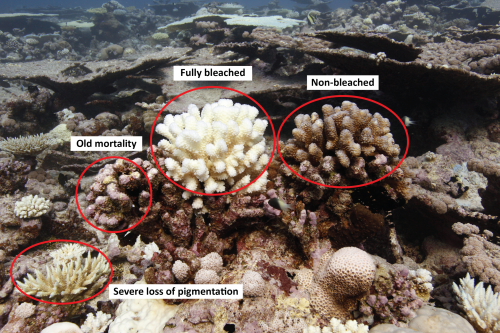
The guidance suggests using four specific timepoints to collect the most informative data: pre-bleaching, peak bleaching, and two post-bleaching timepoints. It also outlines four key metrics for data collection:
- Live coral cover
- Bleaching prevalence
- Bleaching severity
- Recent mortality
The SOP includes a decision tree to help users determine the most appropriate collection method (e.g., in situ or imagery collection), considering factors like staffing and equipment capacity.
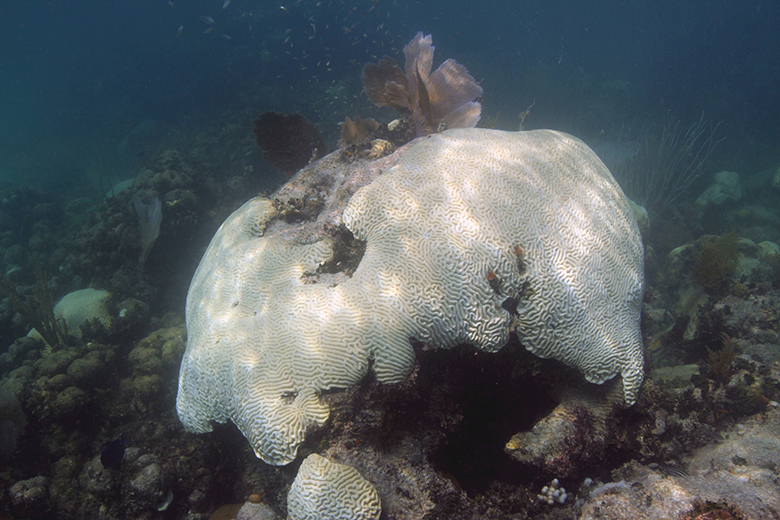
Photo credit: Derek Manzello.
Informing Management Actions
A primary goal of the SOP is to ensure that collected data can effectively inform management decisions. For example, data collected using the SOP can be used to:
- Inform species-specific intervention timelines: Managers can identify which coral species are most affected and prioritize them for interventions, such as transfer to land-based facilities or deeper temporary nursery sites. Conversely, they can identify more resistant species that may have more time before requiring intervention.
- Inform disease response: The data can help establish a timeline for subsequent disease following a bleaching event, allowing managers to better understand when interventions, such as the application of antibiotics, should be applied at affected sites.
A Focus on Simplicity and Capacity
The document is not intended to replace or supersede existing monitoring programs, but rather to provide a simplified, streamlined approach to obtaining quantitative information specific to coral bleaching impacts.
The USCRTF acknowledges the varying capacity levels across the jurisdictions to monitor coral bleaching events, and has worked to ensure the guidance is applicable in capacity-limited situations. It provides details on recommended survey types based on surveyor capacity and training level. While advanced tools like genomics are recognized as useful, the SOP prioritizes low-tech, quick-to-implement methods to improve quantitative data collection without the added complexity of obtaining genetic sampling permits.
For the Coral Reef Community
The USCRTF adopted this new guidance in May 2026, which is a consensus-written product with input and feedback from USCRTF members, including substantial constructive review from the U.S. All Islands Coral Reef Committee.
The USCRTF encourages all partners to embrace this new standardized approach to enhance the comparability and utility of coral bleaching data for effective reef management.
Original article:U.S. Coral Reef Task Force Announces First-Ever Standard Operating Procedure for Coral Bleaching Monitoring, NOAA Coral Reef Conservation Program (2026). [Accessed 28 May 2026].
SOP citation: Pomeroy, Morgan W. et al. (2026). Guidance for monitoring the impacts of heat stress and coral bleaching events : Standard operating procedures from the U.S. Coral Reef Task Force. https://doi.org/10.25923/8xsj-qs43