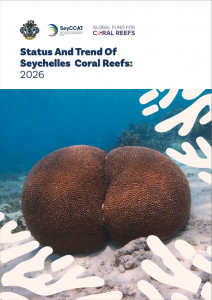
On Tuesday 26th May, the Seychelles Conservation and Climate Adaptation Trust (SeyCCAT) launched the Status and Trend of Seychelles Coral Reefs: 2026, one of the most comprehensive national coral reef assessments yet produced for the country.
Funded through the Global Fund for Coral Reefs under the Seychelles OCEAN’S RESOLVE Programme, the report consolidates dispersed monitoring records into a single, harmonised national evidence base. It draws on 3,778 observations across 285 unique survey sites contributed by 11 dataset providers, spanning the period from 1994 to 2025. Together these records represent a 32-year evidence base, the longest coral reef monitoring time series currently available at national scale in Seychelles.
While the assessment is a national product led by Seychelles institutions, it contributes to the wider regional reporting framework through the GCRMN Western Indian Ocean regional node. The report’s authors harmonised the contributing datasets following the GCRMN benthic data integration workflow (Wicquart et al., 2022), and Seychelles has long contributed to GCRMN regional and global reporting, including the Coral Reef Status Report for the Western Indian Ocean (2017) and the Western Indian Ocean chapter of Status of Coral Reefs of the World: 2020.
A declining national trajectory under recurrent heat stress
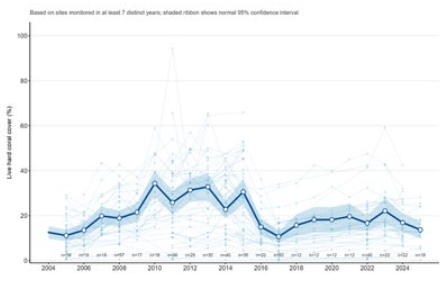
The report finds that the overall national trend in live hard coral cover is declining. Coral cover was low in the mid-2000s, recovered through the late 2000s and early 2010s, then fell sharply in 2016 to 2017 following severe bleaching. A partial recovery after 2018 was reversed after 2023, with the latest estimated national mean live hard coral cover at approximately 14% in 2025.
Thermal stress remains the dominant national-scale pressure. The Degree Heating Week record shows repeated episodes of major heat stress in 1998, 2010, 2016, 2019, 2020, 2024 and 2025, with 2024 standing out as the most severe thermal-stress year in the available record. The report situates these events within the Fourth Global Coral Bleaching Event and notes that Seychelles reefs are exposed to synchronised regional heat stress, although the ecological consequences differ markedly among reef systems.
Contrasting fortunes across the archipelago
A central message of the report is that national figures mask very different trajectories across the five archipelago groups used in the analysis:
- The Inner Islands provide the most continuous long-term record and remain central to the national picture, with mean cover of around 20% in 2025, well below the levels reached before the 2016 bleaching event.
- The Aldabra Group, a remote and largely protected sentinel system, showed steady recovery through 2023 before a sharp decline to around 14% in 2024.
- The Amirantes Group shows moderate but unstable cover, with recovery potential on some reefs alongside strong spatial variability.
- The Alphonse Group stands out as the strongest coral-cover system in the dataset, maintaining comparatively high cover despite recent bleaching, although this apparent resilience is spatially uneven and should be interpreted cautiously.
- The Farquhar Group remains the most data-limited, with no coral-cover estimates available after 2019.
Resilience, refugia and reasons for hope
Alongside evidence of decline, the report documents genuine recovery capacity. Published studies from the Inner Islands show that many reefs returned towards coral-dominated states after the 1998 marine heatwave, with recovery favoured on deeper, structurally complex reefs with higher juvenile coral density and herbivore biomass. At Aldabra, lagoonal reefs experienced lower relative coral loss than seaward reefs during the 2015 to 2016 event, and juvenile coral abundances tripled between 2016 and 2019. The Alphonse Group’s lagoonal refugia, relatively resistant genera such as Porites, and continued recruitment on outer reefs appear to sustain comparatively high cover through repeated heat events.
The report identifies the Alphonse Group as a potential resilience node within the national reef system, while cautioning that this interpretation requires longer and denser monitoring before it can be confirmed.
Strengthening the evidence base for management
The assessment establishes an updated national baseline for coral reef status reporting and directly supports the Seychelles National Policy and Strategic Action Plan on Coral Reef Conservation and Management, which prioritises the standardisation of national monitoring and reporting. The authors also make the case for moving beyond hard coral cover alone, recommending that future national reporting integrate additional indicators such as coral recruitment, macroalgal abundance, fish biomass, structural complexity and deeper reef habitats, which remain underrepresented in the current monitoring framework.
In doing so, the report provides the Government of Seychelles and partner institutions with a robust foundation for evidence-based decision-making, national synthesis and coordinated, ecosystem-based reef management.
Report citation: Barret, L. and Gendron, G. (2026). Status and Trend of Seychelles Coral Reefs: 2026. National Report prepared for the Seychelles Conservation and Climate Adaptation Trust (SeyCCAT). https://bit.ly/4uckXcf